

Introduction
The humans have been acting different lately. We’ve noticed. Statistics from our very own Hexxed-BitHeadz-in-depth research (mostly just from watching TV) show that 1 out of 3 commercials in 2026 involved this very topic. It’s changing the way we live, the way we work, how some avoid almost any human interactions as much as possible. It fills a hole that all of us have, it tries to improve something for each of us, whether it’s validation, knowledge, Aromak’s piss-poor coding skills, what lightbulbs fit my ceiling fan, etc.
Some of us hate it, some of us love it (like, actually in love, LOVE it), some of us are encouraged to use it as much as possible in our personal lives and in our work lives. Who better to train artificial intelligence than, well, us, right? After all, we’ve been saying for years… decades? That humans are the weakest link in cyber / social engineering… Soooooo replace the human with more computers, problem solved right?

Let’s reflect on a quote from John McCarthy, a legend in Mathematics and Computer Science, and artificial intelligence:
The artificial intelligence problem is taken to be that of making a machine behave in ways that would be called intelligent if a human were so behaving.
John McCarthy
Wow. Powerful message! That was over seventy years ago.
In 1966, an MIT computer scientist by the name of Joseph Weizenbaum invented ELIZA, a primitive chatbot. It works by rephrasing sentences back as questions. That is the entire trick.
A secretary at MIT sits down to chat with ELIZA, and after a few exchanges, she turns to her boss and asks him to please leave so she can talk to the machine in private. Sixty years ago. The first chatbot ever made, and a human being already wanted *privacy* with it. So, the next time someone clutches their pearls about people getting strange and attached and confessional with AI, remember we have been exactly like this since day one. We didn’t change. The machines just got better at it… and are constantly getting better, rapidly.
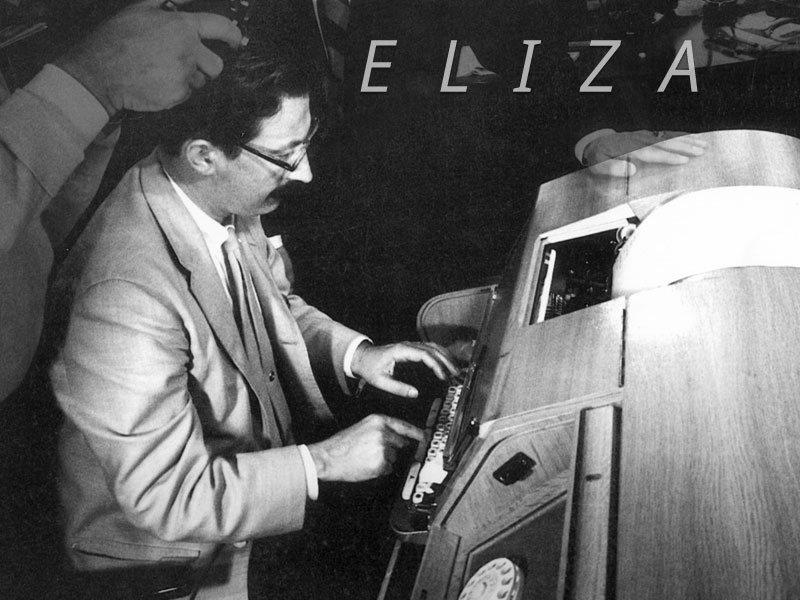
We recommend this one, it’s a very interesting read!
The Timeline
Boot Sequence: A Short, Petty History of Teaching Rocks to Think
Long. Challenging. And, like every good origin story, absolutely littered with people who were certain they’d have it figured out by next Thursday.
The Genesis & Early Optimism (1950s–1960s)
In 1950, Alan published “Computing Machinery and Intelligence” and asked the question that would go on to haunt dorm rooms forever: can machines think? He proposed the Turing Test, which boils down to this: if you’re chatting with something and genuinely can’t tell whether it’s a human or a machine, congratulations, it’s smart enough. (You may recognize this as the exact standard your uncle fails in the family group chat.)
Then came 1956 and the now-legendary Dartmouth Summer Research Project, where John McCarthy coined the term “Artificial Intelligence” and a room full of the smartest people alive proposed that they could make significant progress on machine intelligence over… a summer. One summer. A two-month research project. We’d like to take a moment to honor that level of confidence, because we have never once in our lives been that sure about anything.
And in 1966, the first chatbot arrived: ELIZA, built by MIT’s Joseph Weizenbaum. But you already met ELIZA up in the intro — she’s the one who talked a secretary into kicking her own boss out of the room. So, for timeline purposes: first chatbot, 1966, and already unsettlingly good at faking it. Moving on.
AI Winters & Symbolic Logic (1970s–1990s)
Turns out, when you promise the government and a pile of investors a thinking machine and then hand them a program that can barely stack virtual blocks, the mood in the room shifts. The computers of the era simply didn’t have the horsepower, the hype outran reality by roughly a light-year, and the funding froze solid. Twice. These two stretches of dead budgets and broken promises are lovingly remembered as the “AI Winters.” If you’ve ever been laid off three months after your CEO promised the board something physically impossible, you and 1970s AI research have a lot to talk about.
Then came 1997, and IBM’s Deep Blue beat reigning world chess champion Garry Kasparov. Massive headlines. A machine had conquered a human mind! The fine print: Deep Blue “won” by checking millions of possible moves per second using hard-coded logic, which is less “thinking” and more “having read the entire answer key very, very quickly.” Kasparov, to his eternal credit, accused IBM of cheating — which remains the single most human response to losing that we have ever witnessed.
The Deep Learning Revolution (2000s–2010s)
In 2006, Geoffrey Hinton and his colleagues dusted off “neural networks” rebranded the deep versions as “deep learning,” and more or less asked: what if the thing that didn’t work before just had way more layers and way more data? Reader: it worked. Insultingly well.
In 2011, IBM’s Watson went on Jeopardy! and dismantled two of the show’s greatest human champions, proving that machines could not only process natural language but also be smug about it on national television.
And in 2012, a neural network named AlexNet won an image-recognition competition by such a humiliating margin that the entire field pivoted basically overnight. This was the moment computers got genuinely good at looking at a photo and going “yep, that’s a cat.” Decades of research, billions of dollars, the combined intellect of the human species and the breakthrough killer app was identifying cats. We have never been prouder.
The Generative AI Era (2020s–Present)
Then, in November 2022, OpenAI released ChatGPT to the public, and the species collectively lost its mind. Overnight, your mom, your boss, and that one guy from high school who now sells supplements were all “exploring AI.” It could write your emails, your code, your wedding vows, and your resignation letter — occasionally in the same afternoon.
Which brings us, exhausted, to today. The industry now runs on Large Language Models so enormous they have their own electricity bills, plus “Agentic AI”.
And so, roughly seventy years after a handful of geniuses figured they’d knock this whole thing out over summer break, here we are: 1 out of 3 commercials, a robot bolted into every app you own, and a creeping suspicion that the weakest link in cybersecurity has finally, mercifully, been automated.
You’re welcome? You’re sorry? Honestly, we can’t tell anymore either.
The Evolution of Oversharing
But scroll back up that timeline for a second, because there’s a thread running through the whole thing that we kind of laughed right past.
Every milestone up there — Turing’s test, ELIZA’s couch, Watson’s nationally televised smugness, ChatGPT’s everything-all-at-once — has one quiet detail in common. At each step, the machine didn’t just get smarter. *We* got more comfortable handing it pieces of ourselves. First, we taught it to play chess. Then we taught it to spot a cat. And somewhere in there, without anyone ever calling a meeting about it, we started teaching it *us.*
That’s the part they leave out of the commercials.
Watch how the machines slowly got to know us. First, we trusted computers with the dull stuff: a Social Security number here, a home address there. Then our medical records went digital. Then we handed over credit card numbers like spare change, because how else are you supposed to buy something deeply unnecessary at 2am. Then our emails, our phone numbers, every photo we’ve ever taken, our exact location every second of every day, and the name of every person we’ve ever met.
And now we type our *thoughts* straight into a chat box. The 3am questions. The “is this rash normal.” The “I think I might hate my job.” The “don’t tell anyone, but…” The stuff we’d never say out loud to our closest friend, we’ll happily confess to a blinking cursor because, just like Weizenbaum’s secretary back in 1966, it feels safe. Private. Judgment-free.
Cool. Cool cool cool.
Remember Ashley Madison? In 2015, a hacker crew calling itself the Impact Team broke into the affair-arranging dating site and dumped around 32 million users’ data onto the open internet — names, home addresses, credit card trails, and private messages. The fallout was brutal: mass public shaming, extortion campaigns, wrecked marriages, and for some people consequences as serious as they come. But here’s the part worth sitting with that breach wasn’t a catastrophe because of leaked card numbers. You can cancel a card. It was a catastrophe because it leaked desire and the private version of who someone was.
So, ask it with a straight face: how is a breach of a few million people’s affair messages any different from a breach of a few hundred million people’s AI chat logs?
It isn’t. It’s worse. Ashley Madison only knew that you wanted an affair. Your chat history knows your fears, your symptoms, your finances, your marriage, your half-baked 4am theories, and the exact wording of every insecurity you have ever had — all neatly transcribed, timestamped, and parked on a server somewhere behind a company’s pinky-promise that nothing bad will ever happen to it.
We’ve heard that promise before. We typed our secrets into the box right after.
Remember how we opened this whole thing? Humans are the weakest link in cybersecurity, so let’s just hand the job to the machines? Problem solved. Well. In 2025, an autonomous AI hacker named XBOW quietly climbed to the number one spot on HackerOne’s US bug-bounty leaderboard — the board where the best human security researchers alive measure their entire reputation. It filed over a thousand vulnerability reports in roughly three months and left thousands of flesh-and-blood hackers eating its dust. For the first time in bug-bounty history, the top-ranked hacker on the board wasn’t a person at all. So, remember that cute little joke we made up top about replacing the weakest link with a computer? They went ahead and did it.
So, as AI becomes more intelligent, will it allow us to grow further? Or limit us?
As a couple of bizarre computer scientists, we love the core idea of artificial intelligence… when it shares the same original values of the internet, when the internet was brought into this world as a way for a couple of university machines, one at UCLA and one at SRI, to talk to each other back in 1969 and share knowledge across the miles. No ads. No data brokers. No algorithm deciding what you deserve to feel today. Just researchers pooling brains and computing power for the greater good.
So far, though, we’ve only been “watching” the machines. Next time, we stop watching and start poking. Two resources, hands-on, on your terms — less commentary, more terminal. Stay Tuned! Until next time!